重发优质资料:2026届高三一轮复习之定语从句精讲及精练200题(含答案+解析)
- 2026-05-13 13:44:35

首先说明:精讲A4纸15页;200题精练(含解析)A4纸26页。下面展示部分内容及截图:
定语从句的基础知识,初中的时候已经讲过,但是现阶段的一轮复习,还是有必要再重新系统复习一遍。先来一张定语从句的思维导图:
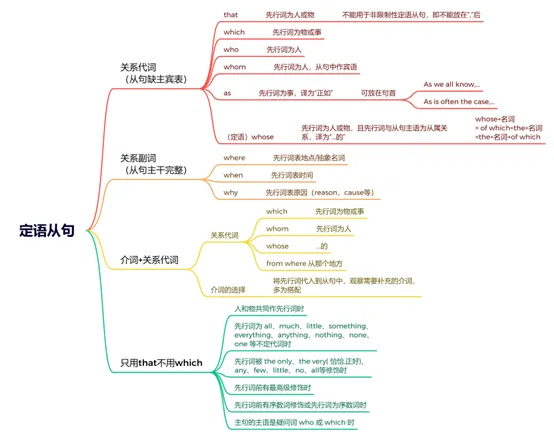
在高考中,高考试题中定语从句的考察重点:
①引导限制性、非限制性定语从句的关系词的用法;
②限制性与非限制性定语从句的区别;
③介词+关系代词的用法;
④不定代词/数词+of which/whom引导的非限制性定语从句;
⑤定语从句与名词从句、状语从句、强调句、并列句、简单句的甄别。
一、定语从句的定义
由关系代词或副词引导一个句子来修饰一个名词、代词或一个句子的从句被称之为定语从句(又称形容词性从句),是跟名词性从句以及状语从句(又称副词性从句)相齐名的三大从句之一。定语从句本质就是一个句子作定语,紧紧跟在所修饰名词(先行词)的后面。定语从句的考查常出现在新高考试题中的语法填空中,写作范文中也常有定语从句出现,尤其是非限制性定语从句。
在复合句中,用于修饰名词或代词的从句称为定语从句。被定语从句修饰的词称为先行词。引导定语从句的词称为关系词。关系词包括关系代词who(宾格whom,所有格whose),that,which和关系副词where,when,why等。
The boywho is wearing a black coat bought an iPod yesterday.穿着黑色外套的男孩昨天买了一个iPod.
The noodlesthat/whichmy mother cooked were delicious. 我妈妈煮的面条很好吃。
The schoolwhere I learned judo was very large. 我学习柔道的学校非常大。
I remember the daywhen our band was formed. 我记得我们乐队成立的日子。
I don’t know the reasonwhyshe got so angry this morning.我不知道她今天早上为什么那么生气。
说明:这几个例子中,先行词分别是boy,noodles,school,day,reason。加下划线的部分为定语从句。处在先行词和定语从句之间的who,that和which是关系代词,where,when和why是关系代词。
二、定语从句的组成和种类
种类
①先行词:被定语从句所修饰的名词或代词,抑或是一个句子;
②关系词:引导定语从句的词,又分成关系代词和关系副词;
③关系词在定语从句中所要充当的成分:关系代词在从句中充当主语、宾语、表语或定语;关系副词在从句中只可以充当状语。
例如:I forgot the website _______ I intended to add to my favorite. It can help me learn how to write English composition.
【答案】which/that
【解析】此处是定语从句,先行词是 the website,指物,在从句中作动词add的宾语,用关系代词that或which引导。句意:我忘了我打算添加到我的收藏夹的这个网站,它可以帮助我学习如何写英语作文。
组成
定语从句可以为限定性定语从句和非限定性定语从句。学习时要明确两者的意义和区别。
1.限定性定语从句
限定性定语从句又称为限制性定语从句,它是先行词在意义上不可缺少的主语,如果去掉,主句的意思就不完整或者就完全失去意义。限定性定语从句和主句的关系十分密切,书写时不可用逗号分开。如果关系代词在限定性定语从句中作宾语,关系代词通常可以省略。
Do you know thegirlwhojust came in? 你认识刚才进来的那个女孩吗?
Shanghai is a city(that) I’ve always wanted to visit. 上海是一座我一直想要去游览的城市。
Her sister married a man(who/whom/that) she met on a plane.她的姐姐嫁给了一个她在飞机上认识的人。
The timewhen I first met Mr. White was a very difficult period of my life.第一次见到怀特先生的时候,我正处于一生中非常艰难的时期。
2.非限定性定语从句
非限定性定语从句又称为非限制性定语从句,它只是对先行词作附加补充说明。如果去掉,主句的意思仍然清楚、完整。这种从句与主句的关系不是很密切,书写时往往用逗号分开。非限定性定语从句一般不用that引导,关系词不可以省略。
The old woman, who lives on her own, has a cat for company.那位老妇人一个人住,有一只猫作伴。
Lori is going to marry Mark, whomshe does not love. 罗丽准备嫁给马克,可她并不爱他。
Beijing, which is the capital of China, is a very beautiful city.中国的首都北京是一座非常美丽的城市。
三、限定性定语从句和非限定性定语从句的区别
限制性定语从句 | 非限制性定语从句 |
与先行词关系密切(删掉后影响整个意思的表达) | 与先行词关系不密切(是一种补充说明,删掉后不影响整个意思的表达) |
不用逗号隔开 | 一般使用逗号隔开 |
可用关系代词that | 不可用关系代词that |
关系代词可以省略(that,who,which在从句中担任宾语时可以省略) | 关系代词不可以省略 |
关系代词可以替代 (whom作宾语可用who或that替代) | 关系代词不能替代 |
读时不停顿 | 读时停顿,用降调 |
只可以修饰先行词,不可以修饰主句或主句的一部分。 | 可以修饰主句或主句的一部分,此时一定有逗号分开,只能由which或as引导。 |
四、关系代词的用法
在定语从句中,关系代词起着连接主句与从句、指代先行词和在从句中作句子成分的三重作用。关系代词的选用取决于主句中的先行词以及关系代词在从句中作何种成分。
关系代词 | 先行词 | 在从句中所做成分 | 是否可省略 |
who | 指人 | 主语、表语或宾语 | 作宾语可省 |
whom | 指人 | 宾语,特别注意作介词的宾语 | 可省 |
whose | 指人或指物 | 定语 | 否 |
that | 指人、指物或事情 | 主语、表语或宾语 | 作宾语可省 |
as | 指人或指主句内容 | 主语、表语或宾语 | 否 |
which | 指物或事情、指主句内容 | 主语、表语或宾语 | 作宾语可省 |
(1)关系代词who和whom的用法
两者都用于指代人,但在用法上存在差别。
1.基本用法
who可以代替人(即它的先行词必须是人),在从句中可以担任主语,往往也可以代替在从句中担任宾格的whom。但它的前面不能有介词,如果带介词则必须用宾格whom,即“介词+whom”。
Johnny is a person who always has novel ideas. 约翰尼是一个经常会有新奇想法的人。(关系代词who在从句中作主语)
The girl who won the first prize is from Jiangsu. 获得一等奖的女孩来自江苏。
She is the girl who/whom I will go to Shanghai with.她就是要和我一起去上海的那个女孩。(关系代词在从句中作宾语,who可以替whom)
The person who/whom you just talked to is Mr. Depp.=The person to whom you just talked is Mr. Depp. 刚刚和你谈话的人是德普先生。
说明:因为把介词to提到宾语从句的句首,所以只能用whom,而不能用who。
We’ll go to the hospital to see the patients,most of whom are children.我们要去医院看病人,这些病人大多数都是儿童。
2.只用who而不用that的情况
在定语从句中who和that指代人时可以通用,但在下列情况下只能用who,而不能用that。
A.先行词是one,ones和anyone时,宜用who。
Onewho has nothing to fear for oneself dares to tell the truth.一个无所畏惧的人敢于说实话。
The oneswho flatter me don’t please me. 那些奉承我的人并不能取悦于我。
Anyonewho laughs lastlaughs best. 笑到最后的人是笑得最好的人。
Anyonewho fails to finish the task given should be criticized.任何不能完成指定任务的人,都应受到批评。
B.先行词是those时,宜用who。
No words are strong enough to express our thanks to thosewho worked hard to rescue survivors in the earthquake.对于那些在地震中为营救生还者而辛苦工作的人,任何言语都无法表达我们的感激之情。
C.当先行词有较长的后置定语时,宜用who。
I met a girlin the streetyesterday who grew up in western Yunnan province.昨天我在街上遇到一个在云南西部长大的女孩。
D.一个句子中带有两个定语从句时,其中一个定语从句的关系代词是that,另一个宜用who。
The boythat you met last night is the group leaderwho studies very hard.昨晚你遇见的那个男孩是个学习非常努力的组长。
E.在there be开头的句子中,宜用who。
There is a young manwho wants to see your father. 有个年轻人想要见你父亲。
There are many old menwho are against this plan. 有许多老人反对这个计划。
There was a kingwho was kind to his people. 有一位国王,他对他的臣民很仁慈。
(2)关系代词whose的用法
关系代词whose是关系代词who的所有格形式,它既可以指代人,也可以指代物。当whose指代物时,相当于of which。whose引导的定语从句既可以是限定性定语从句,也可以是非限定性定语从句。
Do you know Peterwhose father happens to be working in your company?=Do you know Peter? His father happens to be working in your company.你认识彼得吗?他的父亲恰巧正在你们公司工作。
The tourist wanted to book a roomwhose window faces south.=The tourist wanted to book a room the window of which faces south.=The tourist wanted to book a room. The room’s window faces south.这位游客想要预订一间窗户朝南的房间。
We went to see our teacher Miss Styles, whose husband lost his life in the earthquake.我们去看望了我们的老师斯泰尔斯小姐,她的丈夫在地震中丧生了。
Xi’an, whose walls remain as good as before, is one of the few cities with city walls.西安是少数几座有城墙的城市之一,它的城墙保持得和以前一样好。
(3)关系代词that和which的用法
两者都可用于指代物,但使用场合存在差别。
1.在限定性定语从句中指代物时,which和that一般可以通用
The new housethat/which I have just bought is about six miles away.我新买的房子在大约6英里以外。
They planted some treesthat/which didn’t need much water.他们种了一些不需要太多水的树。
2.限定性定语从句中只用that而不用which的情况
A.主句已有疑问句who或which时;
Which of the carsthat are in front of the hotel belongs to you?旅馆前面的小汽车中哪辆属于你?
Who is the manthat is sitting by the lake? 坐在湖边的男人是谁?
B.先行词既有人又有物时;
He talked aboutthe schools and teachersthat he had visited. 他谈到了他访问过的学校和老师。
The bike and its riderthat had run over an old man were taken to the police station.撞倒一位老人的那辆自行车和骑车人都被送到了警察局。
C.先行词为all,much,few,little,something,everything,anything,nothing,none等不定代词时;
It’s easy to do the repair. Allthatyou need is a hammer and some nails.做修理很容易。你所需要的全部东西是一把锤子和一些钉子。
We haven’t got muchthat we can offer you. 我们没有太多能向你们提供的东西。
I’d like to tell you somethingthat will make you surprised.我想告诉你一件会使你感到惊奇的事。
D.先行词有形容词最高级修饰时;
This is the bestwaythat has been used against pollution. 这是用来防止污染的最好的办法。
Polly is the most direct young womanthat I have ever come across.Polly是我所见到的最直爽的年轻女性。
E.先行词有序数词修饰时;
This is the thirdtimethat they have met. 这是他们第三次见面。
The firsttimethat Lester saw the film, he made up his mind to become a director.Lester第一次观看那部电影时,就下定决心要成为一名导演。
F.先行词有the very,the only,the same,any,few,little,no,all,one of等词修饰时
This is the veryroomthat I slept in that evening. 这正是我那天晚上睡过的房间。
Li Ming is the onlyonethat wants to be a teacher. 李明是唯一想当老师的人。
The onlythingthat we can do is to give you some money.我们惟一能够做的,就是给你一些钱。
G.有两个定语从句,其中一个关系代词已用which,另一个宜用that。
Edison built up a factorywhichproduced thingsthathad never been seen before.爱迪生建了一家工厂,生产过去从未见到过的东西。
3.只用which而不用that的情况
A.引导非限定性定语从句时只用which而不用that;
(正)The fish, which I bought this morning, is very fresh.
(误)The fish, that I bought this morning, is very fresh. 我今天早上买的鱼很新鲜。
My house, which I bought two years ago, has got a lovely garden.我两年前买的那幢房子,带一座漂亮的花园。
Jim passed the driving test, which surprised everybody in the office.吉姆通过了驾驶考试,这使得办公室里的每一个人都很惊讶。
注意:在非限定性定语从句中,有时关系代词是指代整个句子,而不是指代一个单词,本句中which指代 “吉姆通过了驾驶考试” 这件事。
Helen was much kinder to her youngest son than to the others, which, of course, made the others envy him. 海伦对她最小的儿子比对其他孩子好得多,这当然使得其他孩子嫉妒他。
说明:本句中,which指代“海伦对她最小的儿子比对其他孩子好得多”这件事。
The factory produces half a million pairs of shoes every year, most of which are sold abroad.这家工厂每年生产50万双鞋,大都销往国外。
补充:which前常用none/neither/most/both/each/all/a little of等词修饰。
London, which is the capital of the UK, is a very beautiful city.英国的首都伦敦是一座非常美丽的城市。
B.在限定性定语从句中,关系代词前有介词时只用which而不用that;
I was put in a positionin which I had to accept I was less important.我被置于一个要被迫接受低人一等现实的境地。
This is the hotelin whichyou will stay.=This is the hotel(which/that) you will stay in. 这就是你将要住的旅馆。
说明:在这句话中,介词in放在了句子的后面,那么关系代词既可以用which,也可以用that,还可以省略。
C.在限定性定语从句中,如果有两个定语从句,其中一句的关系词是that,那么另一句的关系词就需用which。
Let me show you the novelthatI borrowed from the librarywhich was newly open.让我给你看看我从新开放的图书馆借来的小说。
4.关系代词which和that的用法总结
which和that在定语从句中作关系代词的主要区别 | |
which | ①可用于非限定性定语从句中,代替物、整个句子或主句中的一部分 ②可用于介词之后,构成 “介词+which” |
that | 不能用于上述两种情况 |
五、关系副词的用法
关系副词和关系代词一样,具有各种作用:在定语从句中代替先行词、在从句中作状语、把两个句子连接成为一个带有定语从句的主从复合句等。由于关系副词在从句中均作状语,所以具体选用什么关系副词,主要取决于关系副词在从句中充当什么类型的状语。
关系副词 | 先行词 | 在从句中所做成分 | 是否可省略 |
when | 时间 | 状语 | 否 |
where | 地点 | 状语 | 否 |
why | 原因 | 状语 | 否 |
(1)关系副词where的用法
由where引导的定语从句,其先行词主要是表示地点的名词,如building,city,room等,where在从句中作地点状语。
①The hotel was very clean.那家旅馆很干净。
②We stayed there/at the hotel.我呆在那儿/那家旅馆。
③=①+②The hotelwhere we stayed was very clean.我们呆过的那家旅馆很干净。
先行词定语从句
(where在从句中代替there或at the hotel,作地点状语)
补充:可以用关系代词表述
The hotel(that/which) we stayed at was very clean.
=The hotelat which we stayed was very clean.
I got to the stagewhere I wasn’t coping any more.
=I got to the stage(which/that) I wasn’t coping withany more.
=I got to the stagewith whichI wasn’t coping any more.我已经到了无法应付的阶段。
This is the housewhere I was born.这就是我出生的那所房子。
(2)关系副词when的用法
由when引导的定语从句,其先行词主要是表示时间的名词,如time,day,date等,when在从句中作时间状语。
I’ll never forget the timewhen we first met.我永远不会忘记我们第一次相遇时的情景。
先行词定语从句
(when在从句中代替during the time,作时间状语)
补充:可以用关系代词表述:I’ll never forget the timeduring which we first met.
The date(when/that) he joined the ANC Youth League was August 5th.
他加入南非国民议会青年同盟的日期是8月5日。
注意:从语法来讲,这个句子中的定语从句只能用when引导,但在口语中,常用that代替when,也可以省略。
(3)关系副词why的用法
由why引导的定语从句,经常会用在先行词reason的后面,why在从句中作原因状语。
The reasonwhy I got a job was that I worked hard.我获得一份工作的原因是我工作努力。
先行词定语从句
(why在从句中代替reason,作原因状语)
补充:可以用关系代词表述:The reason(that/for) which I got a job was that I worked hard.
The reasonwhy she was late was that she missed her plane.=The reason(that) she was late was that she missed her plane.
注意:一般来讲,在定语从句中,只要先行词是the reason,它的关系副词就是why;和when一样,在口语中,关系副词why常被that代替,也可以省略。
=The reasonfor whichshe was late was that she missed her plane.她迟到的原因是她错过了班机。
Amy didn’t get a pay rise, but this wasn’t the main reasonwhy she left.
=Amy didn’t get a pay rise, but this wasn’t the main reason(that) she left.
=Amy didn’t get a pay rise, but this wasn’t the main reasonfor which she left.
艾米没有获得加薪,但是这并不是她离开的主要原因。
The reasonwhy I’m calling you is to invite you to a party.
=The reason(that) I’m calling you is to invite you to a party.
=The reasonfor whichI’m calling you is to invite you to a party.
我给你打电话的原因是想邀请你参加一个聚会。
补充:带reason的定语从句与表语从句的常用句型
定语从句“The reason why/that...”或“...the reason why/that...”
I know the reasonwhy she studies so well.我知道她学习好的原因。
表语从句“The reason is that...”(不能用why,否则就重复了)
The reason is thathe is always careless in his work.原因是他在工作中总是粗心大意。
六、关系代词和关系副词的选用
对于同一个先行词,要想确定是用关系代词还是用关系副词,关键是要弄清楚关系词在定语从句中担任什么成分。如果关系词在从句中作主语或宾语,就是关系代词;如果关系词作状语,就是关系副词,口语用法除外。
①This is the college(that/which) I visited.这就是我参观过的学院。
②This is the collegewhere I studied three years ago.这就是我3年前在那儿学习过的学院。
说明:两句中的先行词都是the college,但关系词不一样。①用关系代词that/which,因为它在从句中作及物动词visited的宾语。②用关系副词where,因为它在从句中作状语,相当于there或in the college。
①I’ll never forget the day(that/which) we spent together.
我永远忘不了我们一起度过的那一天。
②I’ll never forget the daywhen I got married.我永远忘不了我结婚的那一天。
说明:两句中的先行词都是the day,但是它们的关系词不一样。①用关系代词that/which,因为它在从句中作及物动词spent的宾语。②用关系副词when,因为它在从句中作状语,相当于介词短语on the way。
七、as引导的定语从句
as作为关系代词既可以引导限定性定语从句,也可以引导非限定性定语从句。
(1)as引导的限定性定语从句
1.such...as...和the same...as...的用法
such...as...意为“像……一样的,像……之类”;the same...as...意为“和……同样的”。在这两个句型中,as是关系代词,such和same作定语,修饰主句里的某个名词(或代词),这个名词(或代词)是由as引导的定语从句的先行词,as在从句中可担任主语、宾语或表语。
We have found suchmaterialsas are used in their factory.(as在从句中作主语)我们找到了(像)他们厂里用的那种材料。
I seldom give my students such a difficult problemas they cannot work out.我从来不会给我的学生出这样一道他们不能解决的难题。(as在从句中作宾语)
The result is not the same asthey had expected.(as在从句中作宾语)结果和他们预想的不一样。
比较:the same...that...和the same...as...
两者都引导定语从句。that从句中说明的名词与the same修饰的名词是同一个,as从句中说明的名词与the same修饰的名词是同一类,而非同一个。
He is reading the samebookthatyou bought yesterday. 他看的书就是你昨天买的那本。
He is reading the samebookasyou bought yesterday. 他看的书和你昨天买的书是一样的。(指同一本书;指同一种书,但并不是你买的那一本)
This is the samepenthatI lost. 这支钢笔就是我丢的那一支。
This is the same (kind/type/sort of) penas I lost. 这支钢笔跟我丢的那支笔一模一样。(指同一支笔;指同类型的笔,但并不是我丢失的那一支)
2.such as...的用法
such as...中的such为代词,意思为“这样的人或物”,as在从句中作宾语,修饰先行词such。
This book is not suchasI expect. 这不是一本我所盼望的书。
He told me of his experience suchas I had never had before.他给我讲了他的经验,我从来没有那种经验。
I have not many, but I will send you suchas I have. 我有的不多,但我愿把我所有的都送给你。
补充:such as还可以表示“诸如,例如,像……那样的”的意思,此时其后跟名词或名词短语等,如:They bought a lot of fruit,such as apples,oranges,etc.
他们买了许多水果,如苹果、橘子等。
八、as引导的非限定性定语从句
as可以像which一样引导非限定性定语从句,用来代表整个句子的内容,它的先行词可以是名词,也可以是不定式短语或整个句子。as在从句中作主语、宾语或表语。此外,有些as引导的定语从句已成为固定用法。
as we know正如我们所知 | as is often the case像通常那样 |
as has been said before如上所述 | as is reported正如报道的那样 |
as is well known众所周知 | as was expected正如预料的那样 |
She is very careful, as her work shows. 正如她的工作所展现的那样,她是个细心的人。
As we know, smoking is harmful to one’s health. 正如我们所知,吸烟有害健康。
As is often the case, we have worked out the production plan.像通常那样,我们已经制定出了生产计划。
比较:as和which引导的非限定性定语从句的联系和区别
as和which都可以代替整个句子,当定语从句至于主句之后时,as和which可以互换使用。
He didn’t tell me any news, as/which upset me. 他没有告诉我任何消息,这使我很不安。
which引导的定语从句,代表整个主句时不能放在主句之前。as引导的定语从句,代表整个主句时可放在主句之前或之后,有时也可放在主语与谓语之间。
As is reported in the newspapers, talks between the two countries are making progress.=Talks between the two countries, as is reported in the newspapers, are making progress.正如报道的那样,这两个国家之间的会谈正在进展中。
九、介词+关系代词
句型:名词/代词+介词+关系代词
简单句①The professor gave a lecture to us yesterday.那位教师昨天给我们上了一堂课。
简单句②I couldn’t understand the meaning of the lecture completely.
我不能完全理解那堂课的意思。
合成为定语从句③=①+②The professor gave us a lecture yesterday, the meaningofwhichI couldn’t understand completely.名词+介词+关系代词
那位教授昨天给我们上了一堂课,我不能完全理解那堂课的意思。
简单句①There are around 400 students in our grade. 我们年级大约有400名学生。
简单句②Most of us are from the Xicheng District. 我们中的大多数人都来自西城区。
合成为定语从句③=①+②There are around 400 students in our grade,mostofwhomare from the Xicheng District.代词+介词+关系代词
我们年级大约有400名学生,其中大多数都来自西城区。
十、使用定语从句需注意的事项
(1)定语从句中的主谓一致
A. 定语从句中的关系代词作主语时,从句谓语要与先行词的人称、数一致。
Is he the manwho/that wants to see you? 他就是想见你的那个人吗?
B. as,which作主语引导非限定性定语从句,指全句时,从句谓语用单数。
As is usual, he came to school late this morning. 像往常一样,他今天早晨上学又迟到了。
Liquid water changes to vapor, which is called evaporation. 液态水变成蒸汽,这叫做蒸发。
C.先行词为“one of the+复数名词”时,关系代词为从句主语,谓语用复数。
Freddy is one of the studentswho want to be diplomats in our class.弗雷迪是我们班想当外交官的学生之一。
D.先行词为“the only one of the+复数名词”时,关系代词为从句主语,谓语用单数。
He is the only one of the studentswho has been a winner of scholarship for three years.他是唯一一个连续三年获得奖学金的学生。
(2)what和how不能用于定语从句中
A. what不能用作关系代词来引导定语从句,但是what引导的宾语从句可以与that引导的定语从句互换。
(正)Tell me anything(that) you know.
(正)Tell me what you know.告诉我你所知道的一切。
说明:what引导的宾语从句相当于“anything/all+that”引导的定语从句。
(误)Tell me anything what you know.
B. how不能用作关系副词来引导定语从句。修饰表示方式的way的定语从句用in which来引导,也可用that或省略。
(正)This is the way(that/in which) that boy worked out the problem.
(正)This is how that boy worked out the problem.(how引导表语从句)
(误)This is the way how that boy worked out the problem.
这就是那个男孩解出这道题的方法。
(3)关系代词和关系副词的省略
1.关系代词的省略
A. 在非限定性定语从句中,关系代词不可以省略。
Jane Hasek, who was my former English teacher, retired last year.简·哈塞克今天退休了,他曾经是我的英语老师。
B. 在限定性定语从句中,关系代词用作动词宾语时可以省略。
Sorry, I forget to bring the magazine(which/that) you want. 对不起,我忘了把你要的杂志带过来。(which和that代替magazine,作动词want的宾语,可以省略)
C. 关系代词作介词宾语,如果介词位于关系代词之前,关系代词不可以省略;如果介词位于定语从句的句末,关系代词可以省略。
(正)This is the government buildinginwhich my father works.
(正)This is the government building(which/that) my father works in.
(误)This is the government building in my father works.这是我父亲工作的政府大楼。
D. there be句型之后的定语从句中,作主语或宾语的关系代词常可以省略。
There’s nothing (that) I can do about it. 对此我毫无办法。
2.关系副词的省略
A. 非限定性定语从句中关系副词不可以省略。
She lived in Nagoya for a couple of years, where she taught Chinese.
她在名古屋住了几年,在那儿教中文。
B. 限定性定语从句中,若在口语和非正式语体中,某些表示地点、时间的名词后的关系副词可以省略。先行词the reason后面的关系副词why也可以省略。
This is the plane(where) we first met two years ago.这就是我们两年前初次见面的地方。
He still remembers the time(when) he studied in Berlin.他还记得他在柏林学习的那些日子。
补充:可以省略关系副词when的时间名词有the time,every time,each time,the moment等。
Tell me the reason(why) your brother was absent yesterday.告诉我你哥哥昨天缺席的原因。
(4)定语从句和同位语从句的区别
1.根据that在从句中是否作成分来判定
that在定语从句中担任句子成分,而在同位语从句中不作成分。
The news(that) you told me last week is not true.你上周告诉我的消息不是真的。
(that引导的定语从句,说明是哪一个news,that在从句中担任told的宾语。)
The newsthat the leader will come here is not true.领导将要来这儿的消息不是真的。
(that引导的同位语从句,说明news的具体内容,that在从句中不担任任何成分。)
2.根据意思来判断
在引导词前加is后,如果句子成立就是同位语从句,否则就不是,还是以上面两个例句为例。
The newsthat you told me last week is not true.
→(误)The news is that you told me last week.你上周告诉我的消息不是真的。
(因为the news不能等于you told me last week,所以句子不成立,不是同位语从句,而是定语从句。)
The newsthat the leader will come here is not true.
→(正)The news is thatthe leader will come here.领导将要来这儿的消息不是真的。
(句子成立,所以是同位语从句。)
3.根据that前的名词判断
同位语从句中that前的名词必须是表示事实的抽象名词,如fact,news,information,order,belief,reply,answer,saying等,而定语从句前的先行词没有这个限制,但这一点不是决定因素,主要还要依前面所述的两点来判断。
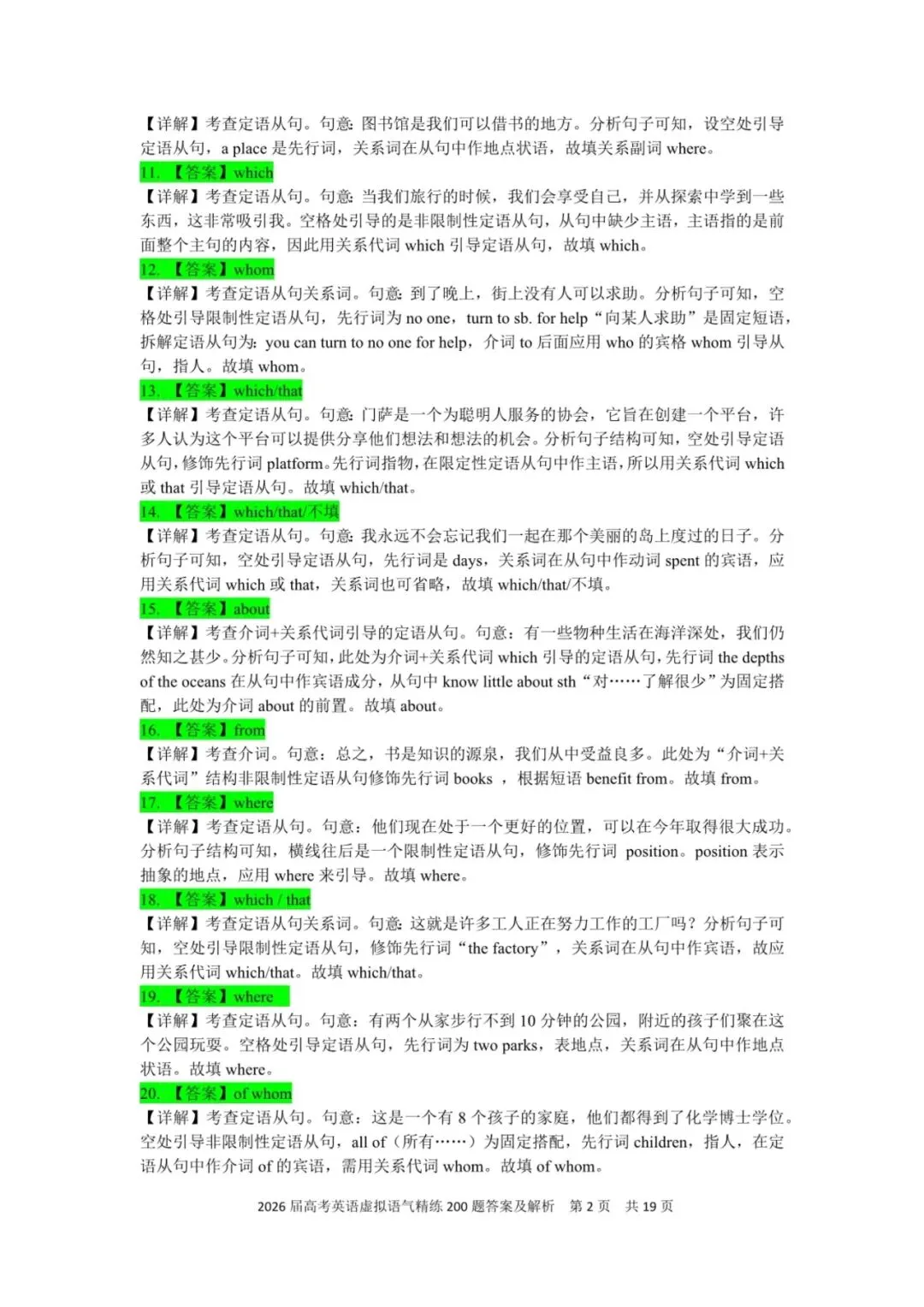
2026届高三一轮复习之定语从句精练200题(含答案+解析)部分内容截图如下
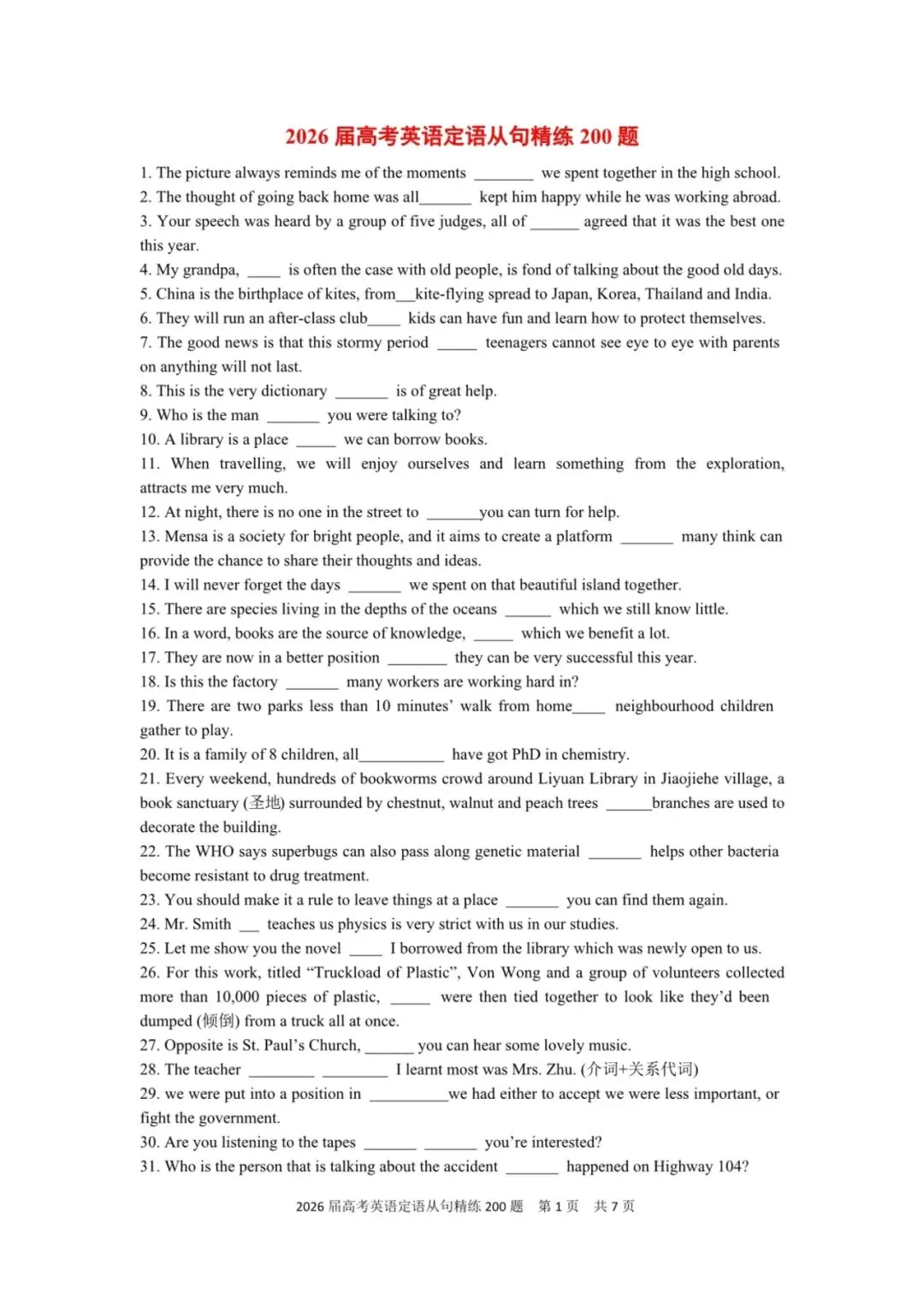
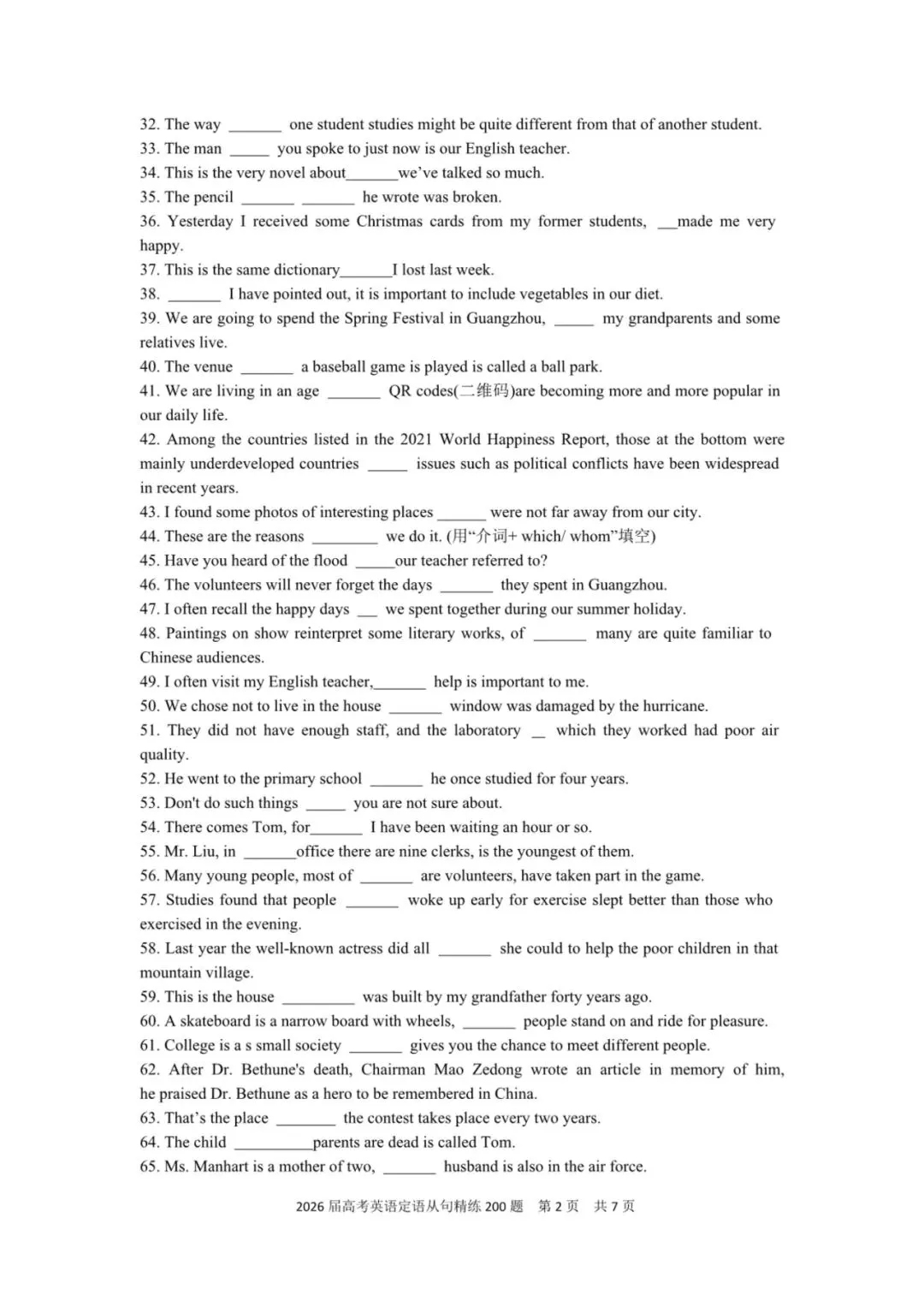
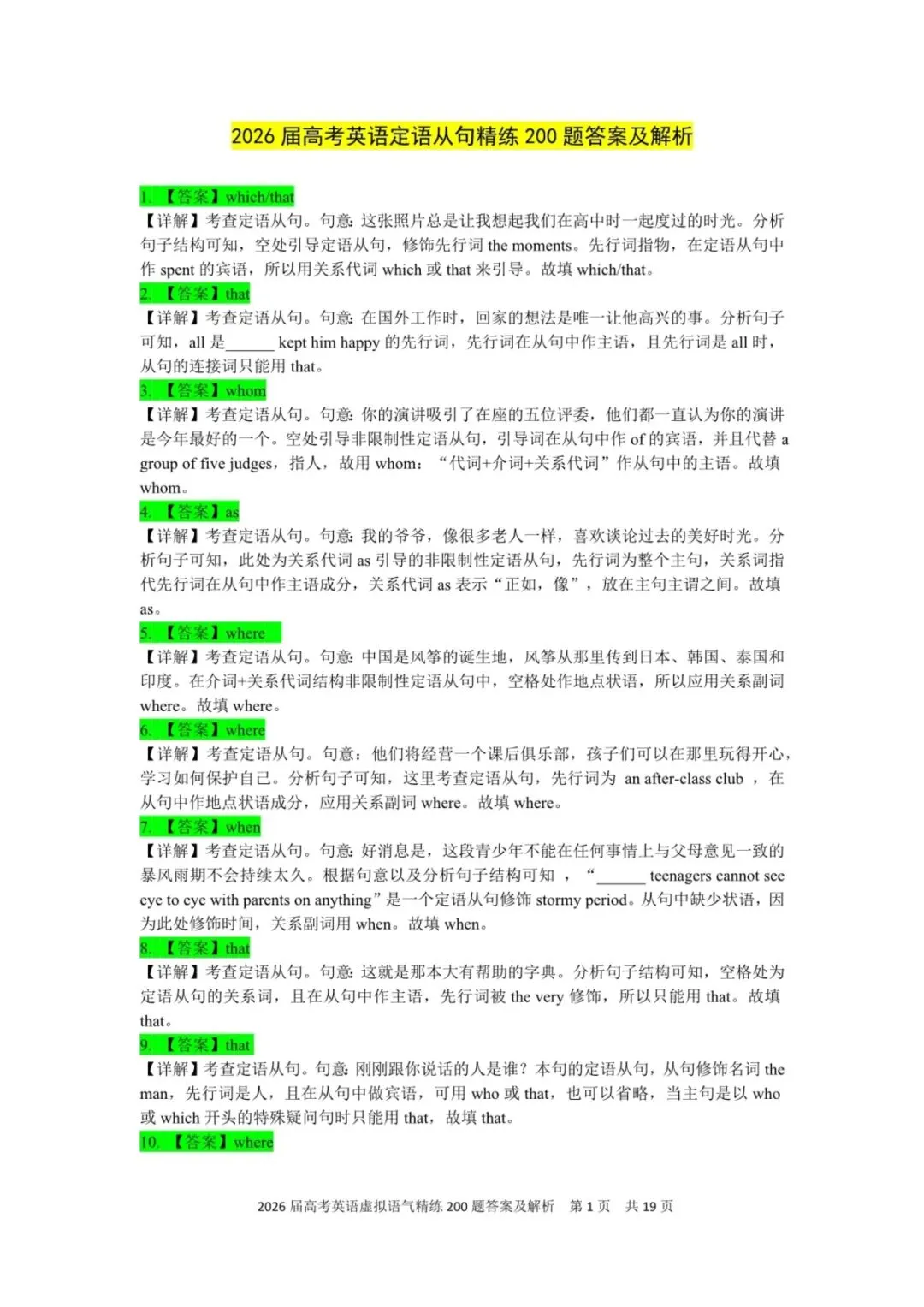
获取《2026届高三一轮复习之定语从句精讲及精练200题(含答案+解析)》的方法:
 点击在看,开开心心卷起来
随机文章
-
 10个月宝宝每天需要喝多少奶粉?
- 教辅资料分享 | 2026小学语文1-6年级上册期末复习资料合集,免费领取~
- 自考03450《公共部门人力资源管理》复习资料+试题及答案
- 小学语文数学英语 全科资料 电子课本 期末复习 押题 期末考试必备知识点 2026年春季 免费下载 资源持续更新中,建议关注收藏【260113】
- 25秋:四年级上册语文《期末总复习重点知识点归纳整理》|完整高清电子版可打印!
- 【湖南省考】2026 湖南省考 资料合集(含历年真题与答案解析+湖南省考考情+合集)
- 四年级上数学期末复习重点必练(可下载打印)
- 高考写作积累 | 一轮复习必背资料:B4U2 发言稿(含范文&词汇&佳句)
- 八年级上册物理期末总复习重点知识
- 【小学资料】25秋四年级上册语文《期末复习知识点(1-8单元写作范文梳理)》电子版可打印
- 【小学资料】25秋四年级上册语文《期末复习知识点(1-8单元园地考点总结)》电子版可打印

